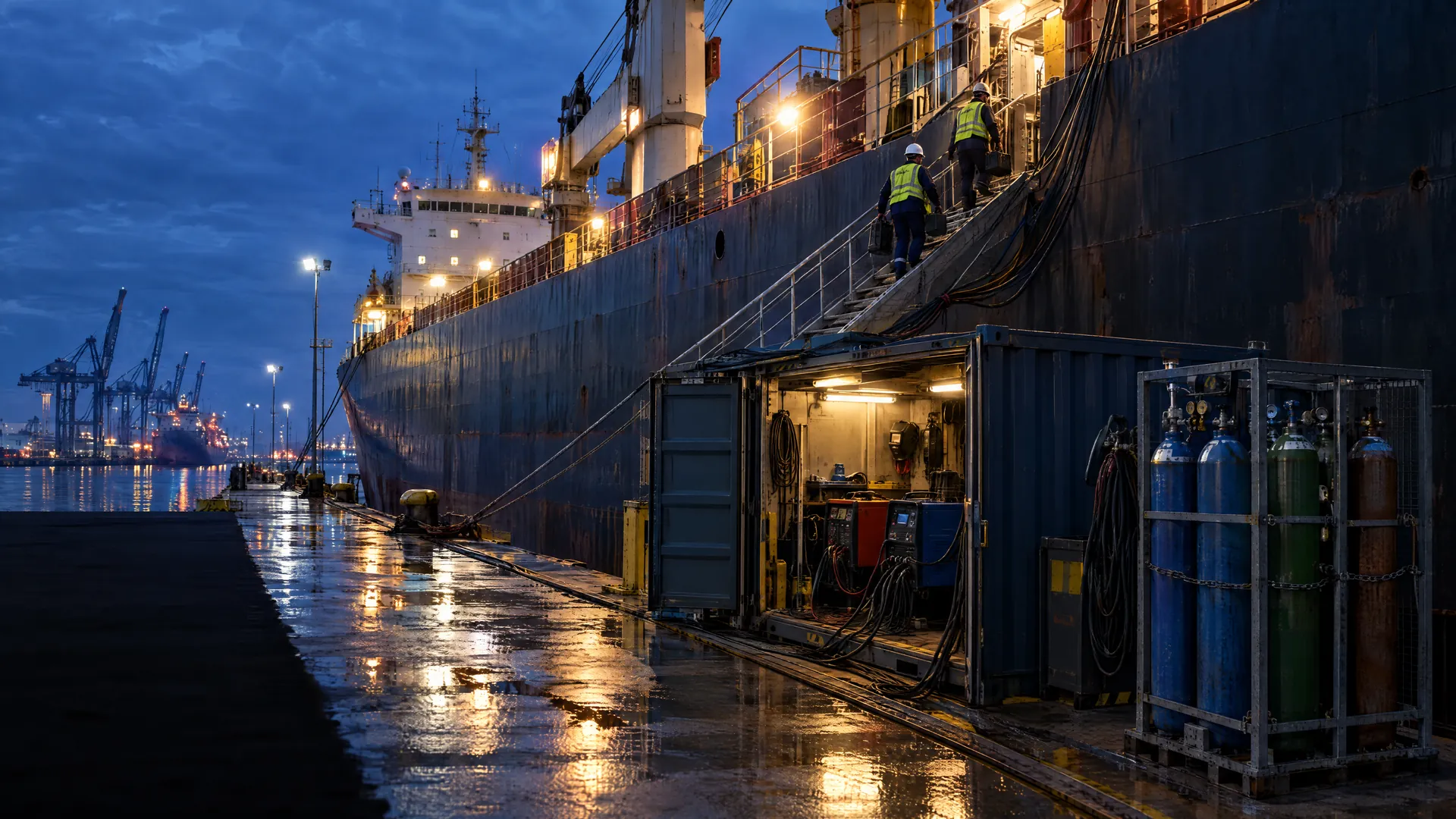
Not every repair needs a dry dock. Many steel, welding and machinery jobs can be done while the ship stays afloat, alongside a quay or at a yard berth. Others need the bottom out of the water, and some are done at sea by a riding squad. Which setting fits depends on the job, on class and on time.
This article explains the three settings and the rules that come with each. It is written for owners, superintendents and charterers who plan repairs around a ship's schedule.
01What does "afloat repair" mean?
A repair carried out while the ship stays afloat, usually alongside in port or at a yard berth. The term is industry language. We have not found a definition of "afloat repair" or "alongside repair" in IMO or IACS documents.
The rules do distinguish between examining a ship in dry dock or on a slipway and examining her while afloat. IACS UR Z3 allows the bottom to be examined afloat as an in-water survey under certain conditions1. For repairs, the same principles apply afloat as in dock: repairs that may affect class are reported to class and carried out as agreed with it14,9.
02What is tied to the dry dock?
Above all, the surveys of the underwater hull. At a bottom survey under IACS UR Z3, the items examined include the shell plating with bottom and bow plating, stern frame and rudder, sea chests and valves and the propeller1. Normally this happens in dry dock or on a slipway; under conditions, an in-water survey can replace it (see below).
How often the bottom has to be inspected is set by SOLAS and class. SOLAS cargo ships need at least two inspections of the outside of the bottom in every five-year period, and the interval between any two may never exceed 36 months2. Class requires the same under UR Z3: two examinations per five-year special survey period, one of them together with the special survey. An extension of three months can be granted in exceptional circumstances1. For passenger ships the annual renewal survey includes the outside of the bottom3.
Not every bottom inspection needs a dock. An in-water survey can replace it if it provides the information normally obtained from a docking survey and is carried out by an approved firm under the surveillance of a surveyor. For ESP ships of 15 years and over, the examination must be done in dry dock1.
03What is a riding squad?
A team of outside workers who board the ship and carry out repairs or maintenance while she stays in service. Britannia P&I describes them as third-party personnel, often called a riding squad or maintenance crew, and gives owners three pieces of advice4:
- If the riding squad works on hull, machinery or equipment that may affect classification, consult the classification society first.
- The squad follows the company's procedures for tasks such as enclosed space entry, hot work and work at height.
- The maximum number of people on board is generally limited by the lifeboat capacity.
If the work is done at a sheltered anchorage or in port, Britannia considers it unlikely that the flag state will require additional measures4.
04Which rules apply to repairs at sea?
Voyage repairs that may affect class are to be planned in advance. Under IACS UR Z13, as implemented in class rules, a complete repair procedure including the extent of the repair and the need for a surveyor's attendance is to be submitted to and agreed with class reasonably in advance. Failure to notify class beforehand may result in suspension of class5.
Emergency repairs that have to be done immediately are recorded in the ship's log and submitted to class afterwards. Routine maintenance to the manufacturer's procedures needs no approval, but any repair resulting from it that may affect class is logged and reported to the surveyor5.
For the hull, IMO guidance is stricter. The guidelines annexed to MSC/Circ.1070 ask that planned repairs to primary hull structure be submitted for review before work starts and that a surveyor attend at regular intervals to confirm fit-up, alignment and workmanship. Riding repairs to primary hull structure should not be permitted except in extreme circumstances7,6. Hong Kong, for example, has promulgated the circular as its guidance on riding repairs8.
Common misreading
UR Z13 does not say that a surveyor must be on board for every voyage repair. It says the need for attendance is agreed with class in advance. Some summaries simplify this.
05How do the three settings compare?
| Setting | Ship | Typical scope | What the rules say |
|---|---|---|---|
| Alongside or at a yard berth | afloat | steel, welding, piping, machinery above the waterline | repairs that may affect class reported and agreed; for hull repairs IACS Rec. 47 Part B as agreed with class9 |
| Dry dock | out of the water | underwater hull, rudder, propeller, sea chests | bottom inspections to SOLAS I/10 and UR Z31,2 |
| At sea, riding squad | in service | as agreed with class | UR Z13 planning; primary hull structure only in extreme circumstances; people on board limited by lifeboats5,7,4 |
The typical scope column is a rough guide, not a rule. What is possible on a given ship depends on the damage, the access and what class agrees to.
For permanent hull repairs, the IACS recommendation Rec. 47 calls for conditions that allow sound work: proper access, staging, lighting and ventilation, and shelter from rain, snow and wind9. Alongside, that is easier to arrange than at sea.
06How does off-hire come into it?
Through the charter party. Under clause 15 of the NYPE 1946 form, hire ceases for the time lost if, for example, breakdown of or damage to hull, machinery or equipment, or dry docking for examination or painting the bottom, prevents the full working of the vessel10,11.
The Court of Appeal has made clear that the clause is triggered by a cause preventing the full working of the vessel, and that the ship is off-hire only for the time thereby lost, not automatically for the whole repair10. BIMCO describes NYPE 2015 as the most widely used standard time charter in the dry cargo sector12. Whatever form is used, what applies is set by the specific charter party.
For owners this means: a repair that can be done alongside during cargo operations, without stopping the ship's work, may not cost hire at all. Whether that is the case in a given situation is a legal question for the parties.
07How does Nauticon work?
We come to the yard, the port or the berth. Our crews travel from Lübeck with their own welding machines, tools and extraction. For urgent cases our SOS service can be reached around the clock.
What we need to plan an afloat repair:
- vessel name, IMO number, berth and how long the ship stays
- a description of the damage with photos
- whether class is informed and whether a surveyor will attend
- drawings and material information for the affected structure
- the port's or terminal's rules for hot work and access
With that, we plan crew, equipment and time, and we send welder qualifications, procedure qualifications and the appointment of our welding coordinator before mobilisation.
08Summary
Many jobs can be done alongside. The underwater hull normally belongs in dry dock, and a riding squad is an option when work cannot wait for the next port. Whichever setting it is: report to class early, agree the scope and the surveyor's role in advance, and keep the charter party in mind. West P&I reminded the industry in 2026 that repairs carried out without the knowledge or attendance of class may lead to suspension of class and put insurance cover at risk13.
Important
This article gives a general overview and is not legal advice. What applies is set by your classification society, your flag state and your contracts.
Written on the basis of the rules and sources listed below. Where a rule applies to one classification society only, the text says so. Technical contact at Nauticon: Şükrü Öztürk, Technical Manager and Welding Engineer (IWE). info@nauticon-systems.com
Sources
- IACS UR Z3 Periodical survey of the outside of the ship's bottom and related items, Rev. 7, 2018 (copy published by the German flag administration). deutsche-flagge.de ↗
- SOLAS, Chapter I, regulations 10 and 11 (transcript on imorules.com). imorules.com ↗
- SOLAS Consolidated Edition 2018, Chapter I, regulation 7 (transcript by the Icelandic Transport Authority Samgöngustofa). samgongustofa.is ↗
- Britannia P&I: Loss Prevention Guidance "Third Party Workers", July 2024. britanniapandi.com ↗
- Croatian Register of Shipping: Rules for the classification of ships, Part 1, Ch. 5, edition 01/2022, 2.6.2.1 "Voyage repairs and maintenance" (implementing IACS UR Z13). crs.hr ↗
- ClassNK: Technical Information TEC-0830, Guidelines for the Survey and Voyage Repairs based on IACS UR Z13, 2010. classnk.or.jp ↗
- IMO MSC/Circ.1070: Ship design, construction, repair and maintenance, with the "Guidelines for the survey of repairs" in the annex, 12 June 2003 (copy by the Turkish Ministry of Transport). denizcilik.uab.gov.tr ↗
- Hong Kong Marine Department: Merchant Shipping Information Note 52/2012, Guidelines on Riding Repairs. mardep.gov.hk ↗
- IACS Recommendation No. 47: Shipbuilding and Repair Quality Standard, Rev. 10 (2021), Part B. iacs.s3.af-south-1.amazonaws.com ↗
- Court of Appeal (England and Wales): Minerva Navigation Inc v Oceana Shipping AG ("The Athena") [2013] EWCA Civ 1723. caselaw.nationalarchives.gov.uk ↗
- UK Supreme Court: NYK Bulkship (Atlantic) NV v Cargill International SA ("The Global Santosh") [2016] UKSC 20. caselaw.nationalarchives.gov.uk ↗
- BIMCO: NYPE 2015. bimco.org ↗
- West P&I: Onboard Repairs – Why Class and Statutory Compliance Matters, 2 February 2026. westpandi.com ↗
- ABS: Rules for Survey After Construction, Part 7, 2017, 7-1-1/7.1 (older edition, copy on canadabuys.canada.ca). canadabuys.canada.ca ↗
Updated: 4 October 2026 · All links last accessed on 4 October 2026. Rules change: what counts is always the current edition that applies to your ship or your plant.