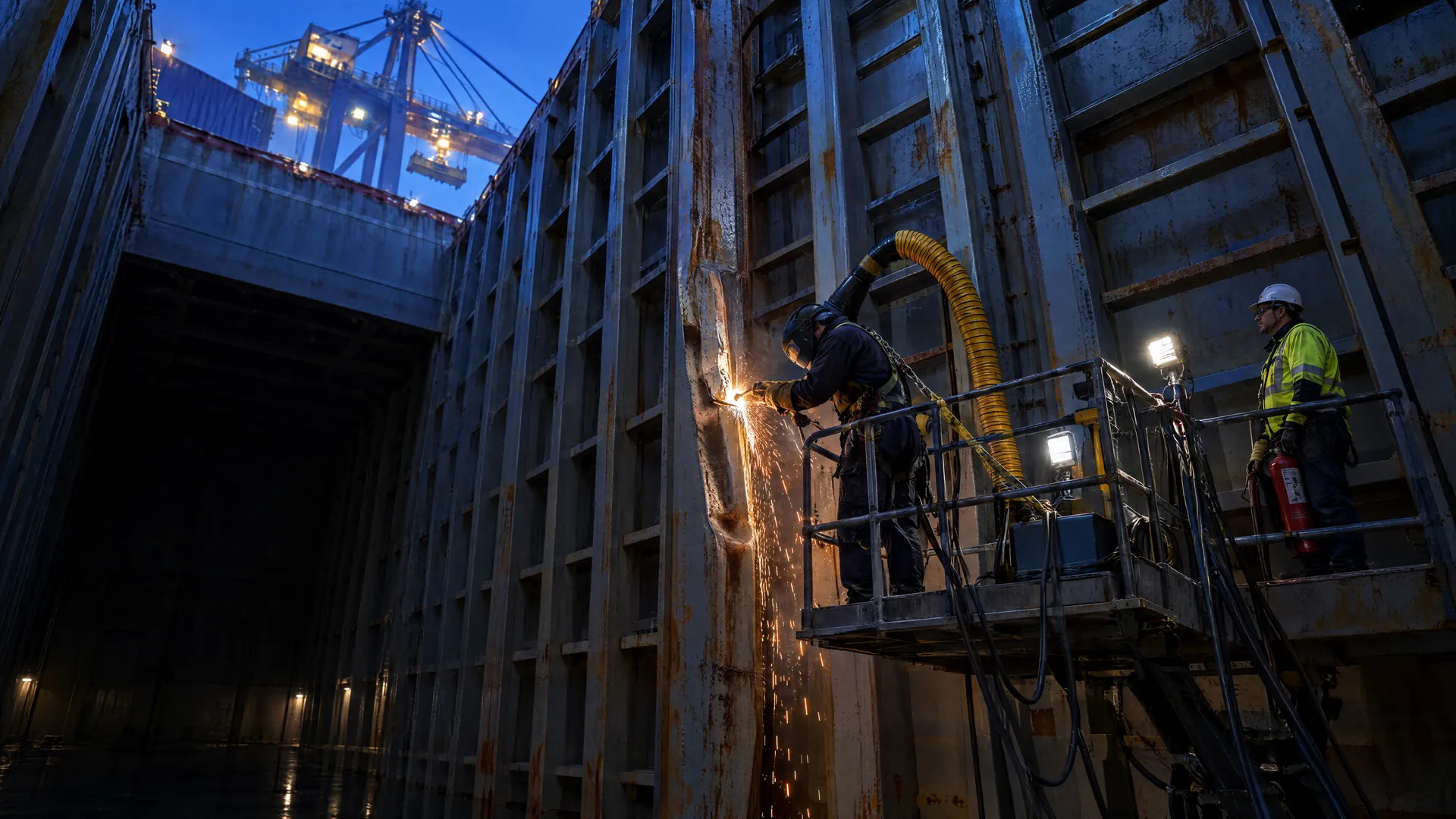
Cell guides are the vertical guides in the hold of a container ship. They lead each container into its slot during loading and keep the stack in place at sea. Class rules also call them guide bars or guide rails.
This article is for shipyards, owners and superintendents who need to assess a damaged guide or plan a repair. Where a figure applies to one classification society only, we say so.
01What are cell guides on a container ship?
A rigid securing system of vertical steel angles. ABS defines cell guides as angles spaced with some margin on container length and width, which align the container stacks and restrain them horizontally1. ClassNK puts it more briefly: the angle bars fix the four corners of the containers. During cargo handling they guide, during the voyage they hold2.
A hold fitted with cell guides is divided into cells, and each cell takes one stack of containers. Most container ship holds are designed for 40 ft containers5. To carry 20 ft containers in 40 ft cells, the Lloyd's Register rules, for example, allow provision for temporary intermediate guides3.
At the top of the guides sit entry guides. They open like a funnel in both directions and pre-centre the container before it slides into the cell2,3. Lloyd's Register lists fixed even peaks, fixed high and low peaks and "flip-flop" systems as typical designs3.
02How are cell guides built?
Generally from steel plate and rolled sections, attached firmly enough to the supporting structure that container loading cannot trip or distort them3. The main parts:
| Part | Function | What the rules say |
|---|---|---|
| Guide angles | guide and hold the container corners | about 150 mm wide and about 12–15 mm thick according to ClassNK2; IRS requires at least 12 mm web and flange thickness4 |
| Cross ties | connect the guides athwartships | under LR generally not more than 3.0 m apart, in line with the container corners where possible3 |
| Intermediate brackets | support the vertical angles | fitted at suitable intervals3 |
| Bulkhead connection | carries the loads into the hull | the bulkhead is to be locally reinforced3 |
| Entry guides | pre-centre the container | of robust construction; nearby structure strengthened against accidental impact3,4 |
The widths and thicknesses are guide values, not fixed standard sizes. What counts are the approved drawings of the ship.
One point matters for any repair: cell guides are not part of the hull girder. Lloyd's Register states that they are not to form an integral part of the ship's structure and should be kept free of the main hull stresses. At the same time they must transmit the loads from cargo handling and ship motions into the hull structure3. That makes the connections the sensitive spots.
03How much clearance does a container have in the cell?
Very little. Under the Lloyd's Register rules the total clearance between container and guide bars must not exceed 25 mm in the transverse and 40 mm in the longitudinal direction. The deviation of a guide bar from its intended line is generally not to exceed 4 mm transverse and 5 mm longitudinal3.
"Total clearance" means both sides together. If the container touches one side, at most 25 mm are left on the other. For comparison: an ISO container is 2,438 mm wide, a 40 ft container 12,192 mm long2. The Standard Club, a P&I club, sums it up: the clearances, and hence the construction tolerances, are very tight5.
These figures come from the July 2022 edition of the Lloyd's Register rules. Other societies set their own requirements; the Indian Register of Shipping, for example, refers to ISO 38744. For your ship, the values of its classification society and the approved drawings apply.
04What damage do cell guides suffer?
The best documented damage is deformation from impacts. IACS, the International Association of Classification Societies, writes in its recommendation for container ships that cell guides and their connections to the side structure can be found deformed or distorted due to mishandling during container stowage6. The hold side structure is also prone to damage from cargo and cargo handling equipment during loading and discharge6.
A research group described the problem in the journal Sensors in 2022. Containers sway while the crane moves them through the cell and hit the guides. This can mean serious downtime while damaged sections are replaced. If the impacts keep hitting the same places over a long time, the ship's structure itself can be damaged7.
An example in the IACS recommendation shows that the damage need not stay in the guide. It describes a fracture at a main hatch corner that started at the welded joint of a cell guide. The repair advice: crop and renew the fractured deck plating, avoid welding the cell guide to the deck plating at the hatch corner, and connect it to the structure below deck level, or integrate it into the hatch corner6.
What follows from this
Welding up a crack leaves the cause in the ship. Where a connection is badly detailed, the change should be agreed with owner and class before anyone starts welding.
05How do you spot a damaged guide?
Usually by eye, reliably only by measuring. The Standard Club advises checking before loading that guides are not bent or deformed, are clear of obstacles, straight and not buckled5. Under the Lloyd's Register rules for annual surveys, the surveyor examines the fixed cargo securing fittings as far as necessary and practicable, to be satisfied as to their general condition13.
Visible signs are dents and kinks in the angles, bent entry guides and cracks at brackets or connections. Whether a guide is still within tolerance only a measurement along its intended line will show. We recommend measuring before and after a repair and recording the values.
06Does class need to attend the repair?
That depends on the damage and on the society. Under Lloyd's Register, fixed fittings which are part of the container lashing equipment or which may affect hull strength are subject to approval. Drawings showing materials, design and scantlings of the cell guide structure are to be submitted8. The initial survey of fixed fittings, including cell guides, is mandatory on all ships9.
Repairs needed for a ship to retain her class are to be carried out to the satisfaction of the surveyors, and damage which could affect the conditions of class is to be reported without delay10. This does not mean every small repair to a guide has to be witnessed. Whether a surveyor attends is agreed case by case between owner and classification society.
IMO also has the topic covered. Its guidelines for the Cargo Securing Manual apply explicitly to container stowage within or without cell guides, and the manual should contain procedures for accepting, maintaining and repairing or rejecting cargo securing devices11. It is worth checking it before the repair.
07How does a cell guide repair work?
This is how we approach it at Nauticon. The sequence is the same on every ship; the scope is not.
- Record the damage. Photos, position of the cell in the hold, affected height, visible cracks at brackets and connections.
- Agree the scope. With the owner and, where needed, with class: will a surveyor attend, which drawings and materials apply, is a poor connection changed?
- Prepare. Hot work only with a fire watch, the hot work permit as required by owner or yard. Hold clear, access and lighting arranged.
- Repair. Cut out and replace damaged sections or bring them back into line. Welding by welders qualified to EN ISO 9606, under welding coordination to EN ISO 14731.
- Measure. Check the guide against its intended line and the class tolerances, record the values.
- Accept. Together with the client and, if agreed, the surveyor, with feedback to you.
08What should you prepare as a client?
The better the first enquiry, the more precise the planning. Helpful:
- vessel name, IMO number and the port or yard where the ship is
- hold and cell, in practice with bay and row
- photos of the damage, ideally with a tape measure in the picture
- the drawings of the cell guide structure, if available on board
- whether class has already been informed
- the time window: port stay or yard period
09Summary
Cell guides are simple parts with tight tolerances. Deformation from impacts is the best documented damage, and a badly detailed connection can crack into the deck structure. Whoever repairs them should think about the cause, agree the scope with owner and class early, and measure the result.
Research is working on the subject too. From 2019 to 2022, Hamburg University of Technology ran the "CellGuide" project, aiming at improved cell guide designs, including retrofit solutions, that secure cargo without lashing12.
Written on the basis of the rules and sources listed below. Where a rule applies to one classification society only, the text says so. Technical contact at Nauticon: Şükrü Öztürk, Technical Manager and Welding Engineer (IWE). info@nauticon-systems.com
Sources
- ABS: Guide for Certification of Container Securing Systems, August 2024, definition of "cell guides". ww2.eagle.org ↗
- ClassNK: Guidelines for Container Stowage and Securing Arrangements, 2nd edition, December 2014, 1.4.3, table 1.4 and table 2.1 (container dimensions to ISO 668). maritimesafetyinnovationlab.org ↗
- Lloyd's Register: Rules and Regulations for the Classification of Ships, July 2022, Pt 3 Ch 14 Sec 7 "Container securing arrangements for stowage using cell guides" (transcript on imorules.com). imorules.com ↗
- Indian Register of Shipping: Guidelines on Container Stowage and Securing, IRS-G-DES-19, July 2025, section 2.2. irclass.org ↗
- The Standard Club with Lloyd's Register: A Master's Guide to Container Securing, 3rd edition, December 2020. iims.org.uk ↗
- IACS Recommendation No. 84: Container Ships – Guidelines for Surveys, Assessment and Repair of Hull Structures (2005, Rev. 1 2017), Part 1, Area 1 example 2-b and Area 2. iims.org.uk ↗
- Jakovlev, S. et al.: Detecting Shipping Container Impacts with Vertical Cell Guides inside Container Ships during Handling Operations. Sensors 22 (7), 2752, 2022. mdpi.com ↗
- Lloyd's Register: Rules and Regulations for the Classification of Ships, July 2022, Pt 3 Ch 14 Sec 1 (approval, plans to be submitted). imorules.com ↗
- Lloyd's Register: Rules and Regulations for the Classification of Ships, July 2022, Pt 3 Ch 14 Sec 10 "Surveys". imorules.com ↗
- Lloyd's Register: Rules and Regulations for the Classification of Ships, July 2022, Pt 1 Ch 2, 3.4.1 (repairs); reporting duty in 1.1.5 at imorules.com/LRSHIP_PT1_CH2_1.html. imorules.com ↗
- IMO MSC.1/Circ.1353: Revised Guidelines for the Preparation of the Cargo Securing Manual, 30 June 2010 (copy published by the German flag administration). deutsche-flagge.de ↗
- Hamburg University of Technology (TUHH), Institute for Ship Structural Design and Analysis: research project "CellGuide – Structural optimization of cell guides on container ships" (2019–2022). tuhh.de ↗
- Lloyd's Register: Rules and Regulations for the Classification of Ships, July 2022, Pt 1 Ch 3 Sec 2, 2.2.44 (annual survey). imorules.com ↗
Updated: 4 October 2026 · All links last accessed on 4 October 2026. Rules change: what counts is always the current edition that applies to your ship or your plant.